"Finally, from so little sleeping and so much reading, his brain dried up and he went completely out of his mind.” (Miguel de Cervantes Saavedra, Don Quixote)
Temperance tips from the king Lear’s fool
FOOL:
Have more than thou showest,
Speak less than thou knowest,
Lend less than thou owest,
Ride more than thou goest,
Learn more than thou trowest,
Set less than thou throwest;
Leave thy drink and thy whore,
And keep in-a-door,
And thou shalt have more
Than two tens to a score.
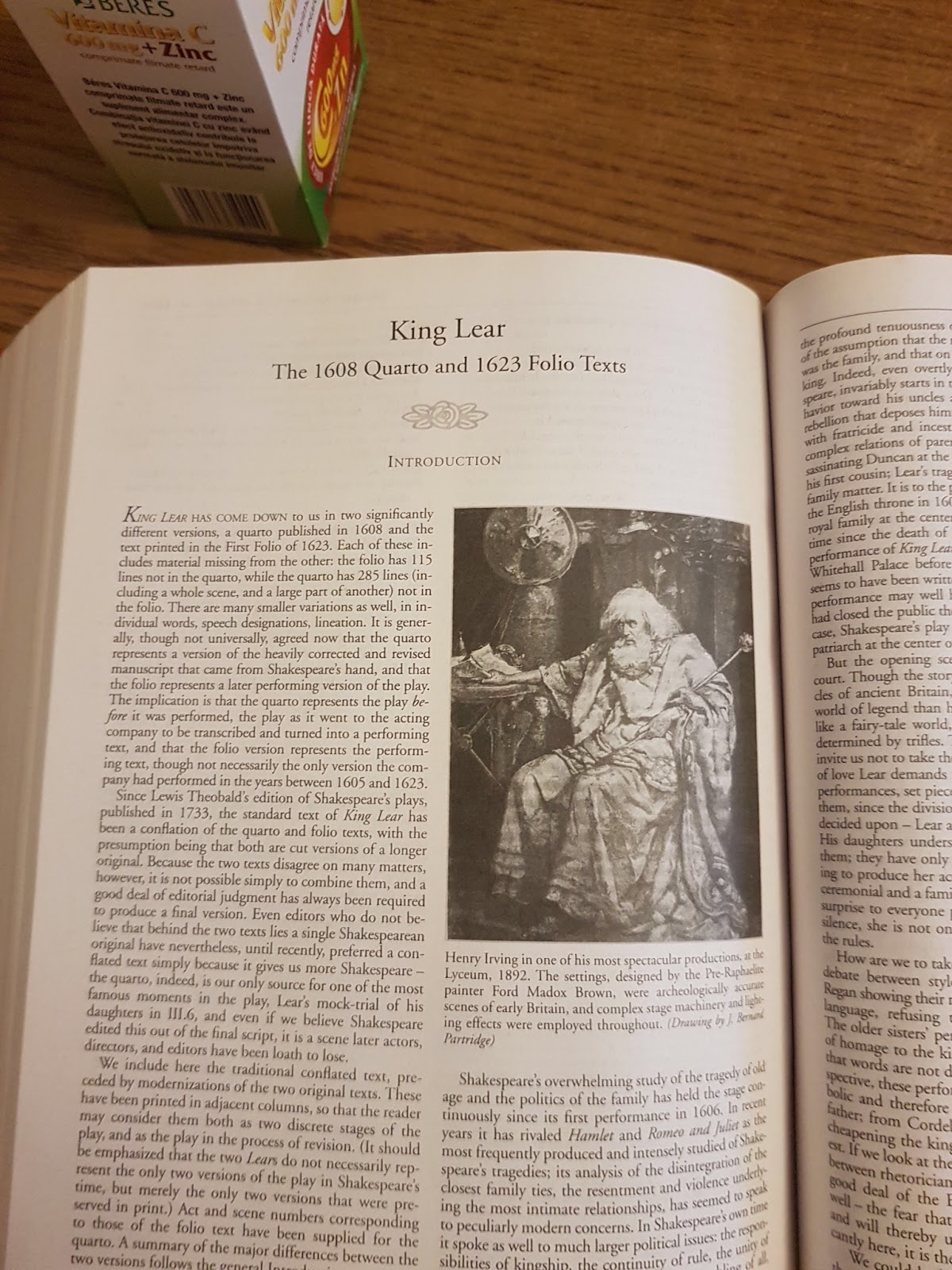
King Lear
Astrology vs good sense
EDMUND: This is the excellent foppery of the world, that when we are sick in fortune - often the surfeits of our own behaviour - we make guilty of our disasters the sun, the moon, and stars, as if we were villains on necessity, fools by heavenly compulsion, knaves, thieves, and treachers by spherical predominance, drunkards, liars, and adulterers by an enforced obedience of planetary influence, and that we are evil in, by a divine thrusting on.
King Lear
Lista de lecturi esențiale
Reputation
Good name in man and woman, dear my lord,
Is the immediate jewel of their souls.
Who steals my purse steals trash; 'tis something, nothing;
'Twas mine, 'tis his, and has been slave to thousands.
But he that filches from me my good name
Robs me of that which not enriches him
And makes me poor indeed.
William Shakespeare - Othello (3.3)
Emilia on men
EMILIA:
'Tis not a year or two shows us a man:
They are all but stomachs, and we are all but food;
They eat us hungrily, and when they are full
They belch us.
William Shakespeare - Othello (3,4)
Beware of jealousy
IAGO:
Oh, beware, my lord, of jealousy!
It is the green-eyed monster which doth mock
The meat it feeds on. That cuckold lives in bliss
Who, certain of his faith, loves not his wronger;
But, oh, what damnèd minutes tells he o'er
Who dotes, yet doubts; suspects, yet soundly loves.
William Shakespeare - Othello (3,3)
Iago on women
IAGO:
Come on! Come on! You are pictures out of door,
Bells in your parlors, wildcats in your kitchens,
Saints in your injuries, devils being offended,
Players in your housewifery, and housewives in your beds.
William Shakespeare - Othello (2,1)
Life is an illusion
MACBETH:
Life's but a walking shadow, a poor player
That struts and frets his hour upon the stage
And then is heard no more. It is a tale
Told by an idiot, full of sound and furry,
Signifying nothing.
William Shakespeare - Macbeth (V, 5, 24)
Lady Macbeth learned from Machiavelli
Lady Macbeth:
[...] To beguile the time,
Look like the time; bear welcome in your eye,
Your hand, your tongue. Look like th'innocent flower,
But be the serpent under't.
William Shakespeare - Macbeth
The power of habit
Assume a virtue if you have it not.
That monster custom, who all sense doth eat
Of habits evil, is angel yet in this:
That to the use of actions fair and good
He likewise gives a frock or livery
That aptly is put on. Refrain tonight,
And that shall lend a kind of easiness
To the next abstinence, the next more easy;
For use almost can change the stamp of nature,
And either shame the devil or throw him out
With wondrous potency.
William Shakespeare - Hamlet
(The New Oxford Shakespeare - The Complete Works, Modern Critical Edition)
(Habit is a terrible thing, in that it’s easy to get used to doing evil without feeling bad about it. But it’s also a good thing, in that being good can also become a habit.
Say no to sex tonight, and that will make it easier to say no the next time, and still easier the time after that. Habit can change even one’s natural instincts, and either rein in the devil in us, or kick him out.[No Fear Shakespeare])
The kind of people Hamlet likes
Since my dear soul was mistress of her choice
And could of men distinguish her election
Hath sealed thee for herself; for thou hast been
As one in suff'ring all that suffers nothing
A man that fortune’s buffets and rewards
Hast ta'en with equal thanks. And blessed are those
Whose blood and judgment are so well co-meddled,
That they are not a pipe for Fortune’s finger,
To sound what stop she please. Give me that man
That is not passion’s slave, and I will wear him
In my heart’s core, ay, in my heart of heart,
As I do thee. -
William Shakespeare - Hamlet
(The New Oxford Shakespeare - The Complete Works, Modern Critical Edition)
(Ever since I’ve been a free agent in my choice of friends, I’ve chosen you because you take everything life hands you with calm acceptance, grateful for both good and bad. Blessed are those who mix emotion with reason in just the right proportion, making them strong enough to resist the whims of Lady Luck. Show me the person who’s master of his emotions, and I’ll put him close to my heart—in my heart of hearts—as I do you. [No Fear Shakespeare])
The most famous soliloquy in the world
To be, or not to be, that is the question:
Whether 'tis nobler in the mind to suffer
The slings and arrows of outrageous fortune
Or to take arms against a sea of troubles
And by opposing end them. To die, to sleep:
No more; and, by a sleep, to say we end
The heart-ache, and the thousand natural shocks
That flesh is heir to: 'tis a consummation
Devoutly to be wished, to die, to sleep -
To sleep, perchance to dream; ay, there's the rub.
For in that sleep of death what dreams may come
When we have shuffled off this mortal coil
Must give us pause. There's the respect
That makes calamity of so long life.
For who would bear the whips and scorns of time,
Th'oppressor's wrong, the proud man's contumely,
The pangs of despised love, the law’s delay,
The insolence of office, and the spurns
That patient merit of th'unworthy takes,
When he himself might his quietus make
With a bare bodkin? Who would Fardels bear,
To grunt and sweat under a weary life,
But that the dread of something after death,
The undiscovered country from whose bourn
No traveller returns, puzzles the will,
And makes us rather bear those ills we have
Than fly to others that we know not of.
Thus conscience does make cowards,
And thus the native hue of resolution
Is sicklied o'er with the pale cast of thought,
And enterprises of great pitch and moment,
With this regard their currents turn awry,
And lose the name of action.
William Shakespeare - Hamlet
(The New Oxford Shakespeare - The Complete Works, Modern Critical Edition)
(The question is: is it better to be alive or dead? Is it nobler to put up with all the nasty things that luck throws your way, or to fight against all those troubles by simply putting an end to them once and for all? Dying, sleeping—that’s all dying is—a sleep that ends all the heartache and shocks that life on earth gives us—that’s an achievement to wish for. To die, to sleep—to sleep, maybe to dream. Ah, but there’s the catch: in death’s sleep who knows what kind of dreams might come, after we’ve put the noise and commotion of life behind us. That’s certainly something to worry about. That’s the consideration that makes us stretch out our sufferings so long. After all, who would put up with all life’s humiliations—the abuse from superiors, the insults of arrogant men, the pangs of unrequited love, the inefficiency of the legal system, the rudeness of people in office, and the mistreatment good people have to take from bad—when you could simply take out your knife and call it quits? Who would choose to grunt and sweat through an exhausting life, unless they were afraid of something dreadful after death, the undiscovered country from which no visitor returns, which we wonder about without getting any answers from and which makes us stick to the evils we know rather than rush off to seek the ones we don’t? Fear of death makes us all cowards, and our natural boldness becomes weak with too much thinking. Actions that should be carried out at once get misdirected, and stop being actions at all. [No Fear Shakespeare])
What a piece of work is a man
I have of late, but wherefore I know not, lost all my mirth, forgone all custom of exercises; and indeed it goes so heavily with my disposition that this goodly frame, the earth, seems to me a sterile promontory. This most excellent canopy, the air, look you, this brave o'erhanging firmament, this majestical roof fretted with golden fire, why it appeareth nothing to me than a foul and pestilent congregation of vapours.
What a piece of work is a man! How noble in reason! How infinite in faculties! In form and moving, how express and admirable! In action, how like an angel! In apprehension, how like a god! The beauty of the world, the paragon of animals! And yet to me, what is this quintessence of dust? Man delights not me - [Rosencrantz laughs] nor women neither, though by your smiling, you seem to say so.
William Shakespeare - Hamlet
(The New Oxford Shakespeare - The Complete Works, Modern Critical Edition)
Reality is much more complex for human understanding
HAMLET :
There are many things in heaven and earth, Horatio,
Than are dreamt of in your philosophy.
William Shakespeare - Hamlet
(The New Oxford Shakespeare - The Complete Works, Modern Critical Edition)
Hamlet is not afraid of a ghost
HAMLET:
Why, what should be the fear?
I do not set my life at a pin's fee;
And for my soul, what can it do to that,
Being a thing immortal as itself?
It waves me forth again; I'll follow it.
William Shakespeare - Hamlet
(The New Oxford Shakespeare - The Complete Works, Modern Critical Edition)
Polonius' fatherly advices to Laertes
Look thou character. Give thy thoughts no tongue,
Nor any unproportioned thought his act.
Be thou familiar but by no means vulgar.
Those friends thou hast, and their adoption tried,
Grapple them unto thy soul with hoops of steel;
But do not dull thy palm with entertainment
Of each new-hatched, unfledged courage. Beware
Of entrance to a quarrel; but being in,
Bear ’t that th' opposèd may beware of thee.
Give every man thy ear but few thy voice.
Take each man’s censure but reserve thy judgment.
Costly thy habit as thy purse can buy,
But not expressed in fancy - rich, not gaudy,
For the apparel oft proclaims the man,
And they in France of the best rank and station
Are of a most select and generous chief in that.
Neither a borrower nor a lender be,
For loan oft loses both itself and friend,
And borrowing dulls the edge of husbandry.
This above all: to thine own self be true,
And it must follow, as the night the day,
Thou canst not then be false to any man.
Farewell. My blessing season this in thee.
(The New Oxford Shakespeare - The Complete Works, Modern Critical Edition)
Hamlet. First soliloquy
O, that this too too sullied flesh would melt,
Thaw and resolve itself into a dew!
Or that the Everlasting had not fixed
His canon 'gainst self-slaughter. O God, God,
How weary, stale, flat and unprofitable,
Seem to me all the uses of this world!
Fie on't! ah fie! 'Tis an unweeded garden,
That grows to seed; things rank and gross in nature
Possess it merely. That it should come to thus:
But two months dead - nay, not so much, not two -
So excellent a king, that was, to this,
Hyperion to a satyr, so loving to my mother
That he might not beteem the winds of heaven
Visit her face too roughly - heaven and earth,
Must I remember? - why, she would hang on him,
As if increase of appetite had grown
By what it fed on; and yet, within a month -
Let me not think on't - Frailty, thy name is woman! -
A little month, or ere those shoes were old
With which she follow'd my poor father's body,
Like Niobe, all tears: - why she, even she -
O, God! a beast, that wants discourse of reason,
Would have mourn'd longer - married with my uncle,
My father's brother, but no more like my father
Than I to Hercules: within a month:
Ere yet the salt of most unrighteous tears
Had left the flushing in her galled eyes,
She married. O, most wicked speed, to post
With such dexterity to incestuous sheets!
It is not nor it cannot come to good.
But break, my heart; for I must hold my tongue.
William Shakespeare - Hamlet
(The New Oxford Shakespeare - The Complete Works, Modern Critical Edition)
Beauty doth varnish age
BIRON:
A withered hermit, fivescore winters worn,
Might shake off fifty looking in her eye.
Beauty doth varnish age, as if new born,
And gives the crutch the cradle's infancy.
Oh, 'tis the sun that maketh all things shine!
William Shakespeare - Love's Labour's Lost (4.3)
Pragmatism vs. sentiment
PRINCESS:
And out of question so it is sometimes:
Glory grows guilty of detested crimes,
When, for fame's sake, for praise, an outward part,
We bend to that the working of the heart;
William Shakespeare - Love's Labour's Lost (4.1)
Beauty is in the eye of the beholder
PRINCESS:
Good Lord Boyet, my beauty, though but mean,
Needs not the painted flourish of your praise.
Beauty is bought by judgement of the eye,
Not uttered by base sale of chapmen's tongues.
William Shakespeare - Love's Labour's Lost (2.1)